Field Trip: İstanbul Craft Neighborhoods: Perşembe Bazaar
- Dec 24, 2025
- 3 min read
Updated: Apr 11
11.07.2024 Tuesday
Özyeğin University, INAR 200.B Interior Architecture Research Internship
Integrative Design: Exploring Ecological Design for Human Habitats | Ecoresearchers
Instructor: Sena Biliş
Field Expert: Aslı Kıyak İngin
Location: Perşembe Pazarı, İstanbul
Within the scope of the INAR 200.B Integrative Design: Exploring Ecological Design for Human Habitats | Ecoresearchers Interior Architecture Research Internship, I guided and accompanied the field trip focusing on Perşembe Pazarı and craft neighbourhoods.
The production and trade ecosystem of craft neighborhoods, and their importance for the city.
Upon the kind invitation of Sena Biliş, I participated as a field expert in the site visit to Perşembe Pazarı, one of Istanbul’s long-established craft neighbourhoods, on Day 9 of the Özyeğin University INAR 200.B - Integrative Design: Exploring Ecological Design for Human Habitats course. Throughout the day-long field trip, I guided and accompanied the visit by sharing my knowledge and experience on craft neighbourhoods, the production and trade ecosystem, and the spatial and social dynamics of Perşembe Pazarı.


Photo credit: Sena Biliş, Aslık Kıyak İngin, Dana Tulaimat and Hatice Kübra Yücel
The field trip focused on observing the area’s ecosystem through on-site exploration, sketching, photography, and collage production. Within this scope, Perşembe Pazarı was approached not merely as a physical setting, but as a multi-layered social, cultural, and economic ecosystem. The exploration process centered on observing the everyday life practices of artisans, shopkeepers, and local residents through the hans, street networks, craft workshops, and the trade ecosystem. Daily encounters and informal interactions provided an analytical framework for understanding how this social ecosystem operates.
The working routines of artisans and shopkeepers, their relationships with one another and with customers, and their ways of using public space, such as street occupation and display practices, reveal that the area generates its own distinctive rhythm and temporality. These everyday practices make visible the unwritten rules and local knowledge embedded in the place.


Photo credit: Sena Biliş, Aslık Kıyak İngin, Dana Tulaimat and Hatice Kübra Yücel
Another significant observation that emerged during the field trip was the shared language, behavioral codes, and life practices developed over time by those who live and work in the area. These collective practices demonstrate that Perşembe Pazarı possesses a distinct character within the city, while simultaneously functioning as an ecosystem that is not independent from Istanbul’s broader economic, social, and spatial networks. While continuously interacting with the city as a whole, the neighborhood maintains its own internal dynamics, forms of solidarity, and production culture.

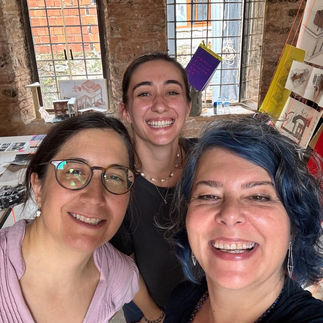


Photo credit: Aslı Kıyak İngin and Dana Tulaimat
These observations enabled students to analyze the human-city-production relationship not only through spatial configurations, but also through social and cultural layers, providing a strong research foundation for subsequent mapping, diagramming, and collage studies.
As part of the field trip, we also visited the exhibition held at Kurşunlu Han within the scope of Istanbul Bilgi University’s IND202 Studio / Entangling With The Han, Heritage / Critical Practices course. The studio and exhibition, conducted during the 2023-2024 Spring semester under the coordination of Bilge Bal and İdil Karababa, explored the han’s potentials for urban memory, production, and community-building, and examined the relationships between space, structure, and program through drawings, sketches, and models.
Özyeğin University, INAR 200.B Integrative Design: Exploring Ecological Design for Human Habitats | Ecoresearchers Interior Architecture Research Internship
Instructor: Sena Biliş
The INAR 200.B course aims to equip first-year interior architecture students with the knowledge and skills necessary to develop integrated human habitats. Through engagement with Permaculture Design and Integrative Design principles, students are encouraged to cultivate an awareness of sustainability and environmental responsibility within their spatial design practices. The program emphasizes understanding the interrelationships between ecological systems, social structures, and the built environment, fostering a holistic design perspective. The 142-page end-of-semester book, which brings together the works produced by students throughout the course, can be accessed here. Ongoing outputs and process-based updates from the course can also be followed via the course’s @ecoresearcher Instagram account.


Selected student works produced through the field trip


